
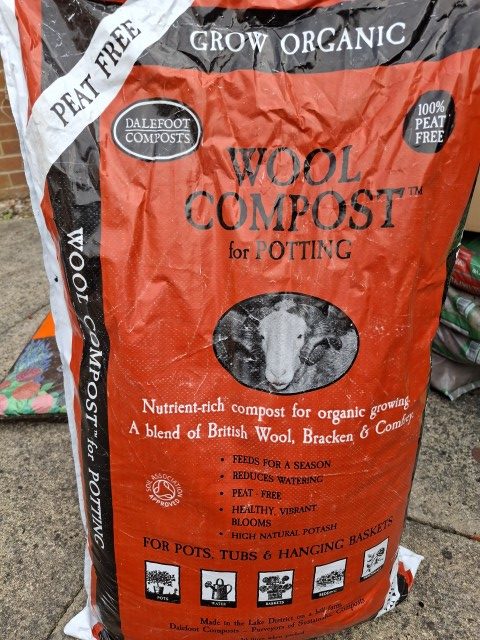
Brand: DaleFoot, Wool MPC | Supplier: Online | Price: £0.43/litre
Personal observations
Dalefoot is marketed around its unusual ingredient list — bracken, wool and comfrey — which makes it one of the more distinctive products in the test. Opening the bag, it looks surprisingly similar to other fine, dark composts at first glance. But on closer inspection there are small wood chips present, which are not listed as primary ingredients. That said, almost nothing was retained above 10mm (less than half a percent), so despite the wood chips the product is well-screened and clean. Water retention is moderate at 2.6 times dry weight, slightly above average. The interesting characteristic is what happens when wetted: unlike many competitors it becomes sticky and cohesive, which suggests the wool fraction is contributing to moisture binding in a way that differs from standard fibre-based products. Whether the ingredient story justifies the premium is a matter of gardening philosophy as much as performance data.
Quick-test data (April 2026)
| Metric | Band | Value | Context |
|---|---|---|---|
| Bulk density (dry) | M | 0.22 g/ml | Mid-range — typical mature organic |
| Water held per g dry weight (WHC) | M | 2.6× | Typical organic range — possibly wool-assisted |
| Dry-down time | — | 20 min | Average |
| Sieve: <2mm fraction | — | 55.4% | Moderate-high |
| Sieve: 2–10mm fraction | — | 43.3% | Moderate |
| Sieve: >10mm fraction | — | 0.4% | Negligible — very clean despite wood chip presence |
| Price per litre | Premium/Specialist | £0.43 | Online only — P&P included in price shown |
WHC within the typical organic range. The wet-sticky behaviour observed on rewetting suggests the wool fraction may contribute hygroscopic binding beyond what the WHC figure captures — a qualitative differentiator that the test method does not fully measure. Wood chips present on inspection despite not being listed as a primary ingredient.
Price includes P&P — online only. Not available at mainstream retail. The premium reflects both specialist ingredients and distribution costs. In-store equivalents at similar compost quality would typically be £0.18–0.25/l.
Comparative hands-on testing, April 2026. Consistent method across all 18 products. See methodology note.
At-a-glance rating breakdown
| Category | Weight | Score | Notes |
| Ease of use | 40% | 7.2 | Free-draining but moisture-retentive once wetted. |
| Composition & quality | 35% | 7.2 | Distinctive wool-based formulation with slow nutrient release. |
| Sustainability | 25% | 7.2 | Uses UK-sourced waste wool and bracken. |
| Overall (weighted) | 100% | 7.2 / 10 | Higher-scoring specialist MPC-adjacent product. |
Typical user fit
| User type | Fit rating | Why |
| Container gardener | High | Excellent moisture buffering. |
| Raised bed grower | High | Slow-release nutrients support steady growth. |
| Casual gardener | Medium | Needs guidance on wetting and handling. |
Our conclusion
Overall impression: Dalefoot Wool Compost is a well-designed specialist option with high sustainability credentials. The major downside is limited geographical outlets – available online, but P&P substantially increases the price.