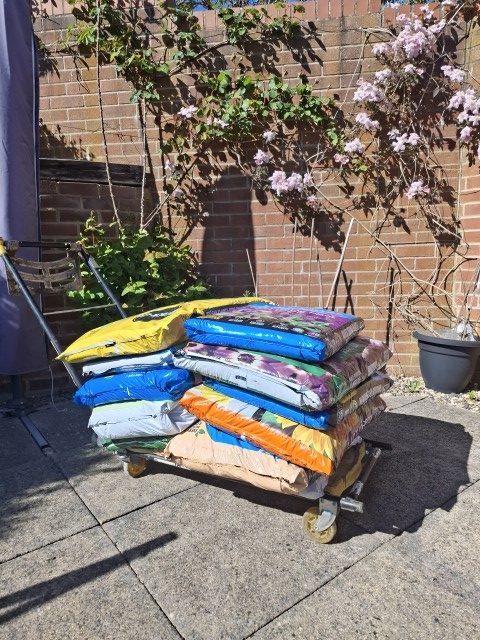
It frustrates me no end walking into a garden centre and seeing twelve versions of compost, all from the same company.
So what’s actually going on? Here’s an honest breakdown.
Quick answer: Most products labelled “multipurpose compost” are not compost in the soil-building sense. They’re growing media — blended materials designed for pots, containers, and seedlings. The range of products is driven by a mix of genuine differences, small formulation tweaks, and retail shelf competition.
First, a terminology point
The word “compost” covers two quite different things, and most of the confusion starts here.
Growing media is designed for:
- Seed germination
- Young plants
- Containers and planters
Compost as a soil improver is designed for:
- Improving soil structure
- Adding organic matter
- Supporting long-term soil biology
Most products sold as “multipurpose compost” fall into the first category. They’re typically lightweight blends of wood fibre, coir, and green compost — consistent, manageable, and suited to short- to medium-term plant support. They’re not soil-building materials.
So why the long list of products?
1. Some differences are real
Seed and cutting compost is one of the few genuinely distinct categories. It uses lower nutrient levels (to avoid scorching seedlings), finer particle sizes, and more consistent moisture behaviour.
Worth knowing: many seed composts use the same base materials as multipurpose mixes. The difference is often in processing — more screening, removal of coarser wood fractions, tighter blending — rather than entirely different ingredients.
Ericaceous compost is also a real category. Acid-loving plants like rhododendrons and blueberries need lower pH and adjusted mineral balance.
There’s a useful insight here though: most growing media is naturally acidic. Standard multipurpose products have lime added to bring the pH up towards neutral. Ericaceous compost often works by simply not making that adjustment. Sometimes what defines a product is what’s left out, not what’s added.
Soil improvers — actual composted material for beds and borders — are also genuinely different. These build soil structure and support long-term biology. They tend to get less shelf space than they deserve.
2. Some differences are smaller than they appear
Tomato, rose, and vegetable composts are typically positioned as tailored solutions. In many cases, the base mix is similar to multipurpose, with nutrient tweaks, added fertiliser charges, or wetting agents making up the difference.
In peat-free ranges, wood fibre content is the bigger variable. Higher wood fibre means freer draining and lighter. Lower wood fibre means denser and more water-retentive. Two products with different labels can behave similarly if their wood fibre profile is close.
3. Retail shelf space is a real driver
Retailers allocate limited shelf positions and tend to favour brands with broader ranges. A brand offering six or eight variants is more likely to secure multiple facings than one offering two. More shelf presence means more visibility, which means more sales — so the incentive to extend product lines is structural, not just about serving gardeners.
4. Labels carry more weight than formulations
For most gardeners, a label that says “tomato compost” reduces uncertainty. It signals “right product for the job.” Whether the mix differs meaningfully from multipurpose is secondary — the label does the decision-making work.
What actually matters when choosing
- Intended use: seed and propagation, containers, or open soil?
- Ingredients: wood fibre content, coir, green compost, digestate
- Structure and consistency: does it hold moisture without compacting?
Watering practice, feeding regime, and basic plant care tend to have a bigger effect on results than switching between similar variants.
A cleaner way to read the range
| Product | What it actually is |
|---|---|
| Seed compost | Specialised growing media |
| Ericaceous compost | pH-adjusted growing media |
| Multipurpose compost | General-purpose growing media |
| Tomato / rose / veg | Variants of growing media |
| Soil improver | True compost — soil-building material |
Related questions
- What is the difference between growing media and compost?
- Can multipurpose compost improve soil?
- What ingredients matter most in peat-free compost?
SEO: title — Why do compost brands sell so many types? | description — Most compost products are actually growing media. Here’s why brands offer so many types and what actually matters when choosing. | slug — why-so-many-compost-types